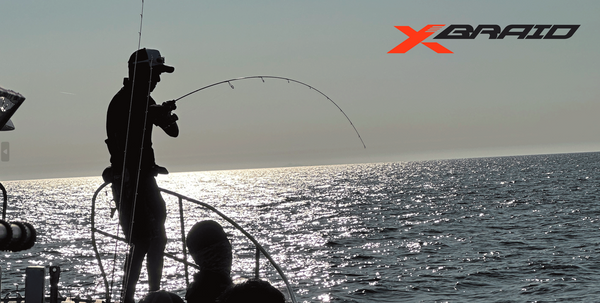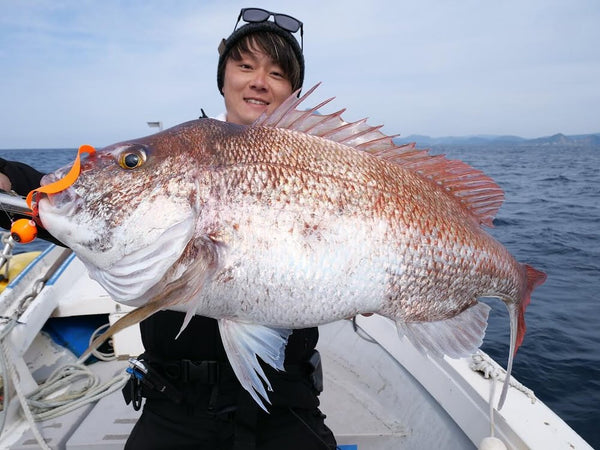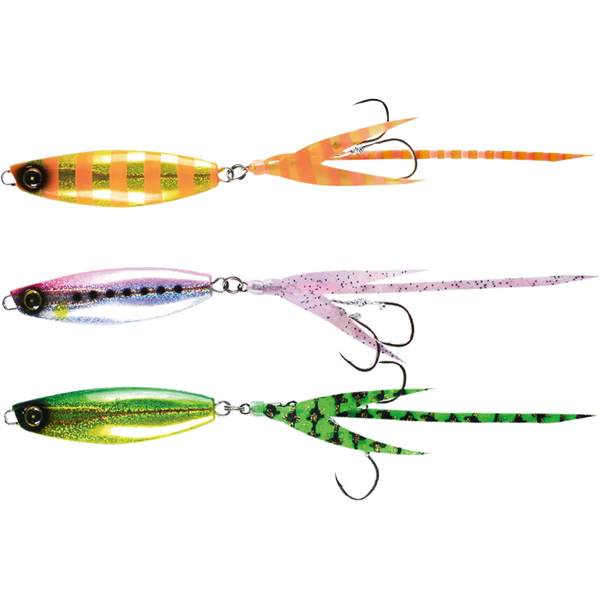
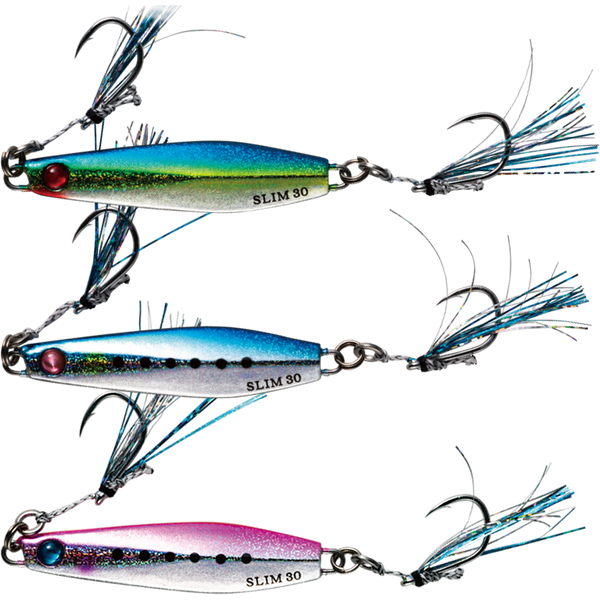
Slow pitch jigging looks technical, but it doesn't have to be. Start with a light jig that flutters on its own, fish it like a bait, and let the fish eat it on the way down. This guide covers the three jigs to start with, two ready-made kits, the one rule for jig weight, your first drop step by step, and the mistakes to skip.

The basics

What slow pitch is, and why it works

Slow pitch: you lift (pitch) the jig gently and slowly, and fish it on the fall.

Jig

A flat metal lure

A jig is a metal lure with the hooks at the head. A slow pitch jig is flat or curved, so it sinks slowly instead of dropping like a sinker.

Flutter

It wobbles on the way down

As it sinks, the jig wobbles and slides side to side like an injured baitfish. You don't have to make it do anything.

Fall

Fish eat it on the drop

Most bites come while the jig is falling, so the flutter does the work. Your job is to keep it near the bottom and watch the line.

Ready-made kits

Two starter kits

A rod, reel, braid, leader, three jigs and spare hooks at a kit price. Braid is the thin main line (PE1 is about 22lb); the leader is clear fluorocarbon tied between the braid and the jig.

Everything you need to start

Entry kit

Everything you need to start

The Assassin Jigmaster II 6M spinning rod (30 to 120g) with a Daiwa Legalis LT3000 spinning reel, 150m of XBraid PE1 and 20lb FC Absorber leader. Three jigs at 30g, 40g and 60g cover roughly 15 to 30 metres.

Kit price · all 8 items$499$526.20Save $27.20
Add the kit to cart
Lighter, with more feel

Step-up kit

Lighter, with more feel

The Palms Metal Witch Quest A 6102, a 6'10" spinning rod for 30 to 100g jigs with a solid tip that shows light bites, on a Shimano 24 Vanford C3000XG. Same XBraid PE1, leader and three jigs in other colours.

Kit price · all 8 items$899$948.50Save $49.50
Add the kit to cart

The one rule

About 2g of jig per metre of depth

Go heavier in a drift, and up a size if you can't feel the bottom. Matches the chart in our slow pitch jig guide.

10m

20g

The lightest starter jigs.

20m

40g

The middle of the starter range.

30m

60g

The heaviest of the three starter jigs.

40 to 60m

100g to 150g

Past the starter jigs: see the full chart.

Heavier jigs: slow pitch jig guide

Boat control

Drift, drift, drift

Slow pitch works best with the line going straight down.

1

Find them first

Mark fish or bait on the sounder, then motor up-drift of the mark so the wind and tide carry you back over it.

2

Check your speed

Common practice is a drift under about 1 knot, ideally around half a knot, so the line stays close to vertical.

3

Watch the line angle

Line angle is your speedo. Straight down is a good drift; the further the line angles away from the boat, the faster you're going.

4

Too fast? Drogue out

Put out a drogue: a drift chute, a small parachute on a rope that drags in the water and slows the boat. Sizes for your boat are below.

5

Still angling? Go up a size

If the line still angles out past about 45 degrees with the drogue out, go up a jig size so it gets back to the bottom.

6

Reset to the top

Once you've drifted off the mark, wind up, motor back up-drift and drop again at the top of the mark.

Boat control

The Handbrake drift chute

Slows your drift so the jig stays near the bottom. Pick the size for your boat.

Ocean Angler Handbrake drift chute
Boats 3 to 4mSmall · 5ft chute
$188$216.80Save $28.80 Shop
Boats 4.5 to 6mMedium · 7ft chute
$239$267.80Save $28.80 Shop
Boats 6 to 9mLarge · 12ft chute
$338$366.80Save $28.80 Shop

Step by step

Your first drop

Fish it like a bait: get it to the bottom, keep it there, and watch the line.

1

Drop

Open the bail and let the jig sink. Rest a finger lightly on the spool so the line comes off smoothly without a loose loop.

2

Watch the line on the way down

If the line stops or jumps before the bottom, that's a fish. Close the bail and wind until you feel weight.

3

Engage on the bottom

When the line goes slack, the jig has hit the bottom. Close the bail and wind in the slack straight away, before it snags.

4

Fish it like a bait

Lift the rod tip slowly, about an arm's length, then lower it so the jig flutters back down. Or wind slowly for 10 to 15 turns.

5

Drop back down

Open the bail and let it go back to the bottom. Most fish sit within 10 metres of the bottom, so keep it there.

6

When it goes heavy, wind

Don't strike hard. Keep winding at a steady pace; the rod bends and the hooks set themselves.

The next step

Once you're comfortable: the short pitch

The basic slow pitch action, for when the bait-style method feels easy. It's the next step, not the starting point.

Wind

A short turn and a lift

Turn the reel handle a quarter to a full turn while lifting the rod tip, so the rod springs back and pitches the jig up.

Drop

Drop the tip

At the top of the lift, drop the rod tip straight away. The jig loses tension and flutters sideways: that's when fish bite.

Repeat

Work the bottom 10 to 20m

Repeat for 10 to 20 metres off the bottom, then drop back down.

The full technique: slow pitch jig guide

Where and when

Where and when to try it in NZ

Good first spots and days: water you can reach the bottom in with a 30g to 60g jig, about 15 to 30 metres.

15 to 30m

Reef edges, foul and pins

Snapper, gurnard, trevally and john dory feed close to the bottom over rough ground. Drop on the edge of reef or foul on your sounder.

Sand

Sand and shell next to reef

Gurnard and snapper cruise the sand beside reef. The Kunekune's slow wobble works on a lift and drop here.

Workups

Under birds and bait

When birds are diving on bait, drop to the bottom underneath: snapper and kahawai often sit below the work-up.

Calm days

A light wind and slow drift

A slow drift keeps the line straight down, so light jigs reach the bottom. Save windy days for later.

Spring to autumn

The easy months

Snapper move shallower from late spring, so they're in reach of the starter jigs. In winter they go deeper; use heavier jigs.

Tide

Around the tide change

Slack water lets light jigs reach the bottom; the hour either side of the change is often the bite time.

Skip these

Beginner mistakes

Three things that cost beginners the most fish.

Too heavy

The jig is too heavy

A heavy jig drops like a sinker and barely flutters. Use the lightest jig that still reaches the bottom.

Too hard

Working it too hard

Big rips pull the jig away from the fish. Small, slow movements; the jig does the work.

Slack

Slack line on the drop

A loose loop of line hides bites and tangles. Keep a finger on the spool so the line stays just tight as it sinks.