

The bib
What a bibbed hardbody is and why it works
The lip at the nose turns forward motion into a dive and a wobble. Its size and angle set the depth and the speed band.
Dive and wobble
Water pushing on the bib drives the nose down and rocks the body side to side. Boating NZ: the size, shape and angle of the bib determine the depth it runs and the speed it can be trolled at.
Bigger bib, deeper lure
The bigger the bib and the shallower its angle, the deeper the lure swims and the slower it must be trolled. Halco grades the Laser Pro bibs STD, DD and XDD: 1 m, 2 m and 6 m on the 160 and 190; 4.5 m and 9.1 m on the 210.
Floating or sinking
Every Laser Pro from 120 up floats: stop the boat or pause the retrieve and it rises, which lifts it off a reef and resets the track. The 45 is the exception, a slow sinker for casting.
A speed band, not a speed
Each hardbody has a band it swims best in: too fast and it spins or breaks out. Halco rates the 190 for 3 to 11 knots with the optimum about 6.5; the 120 and 140 for 1 to 7; the 210 to 12.
Which size
Which Laser Pro for which fish
Halco's own size guidance and the lure sizes New Zealand writers use. Prices and stock are live.

Kahawai
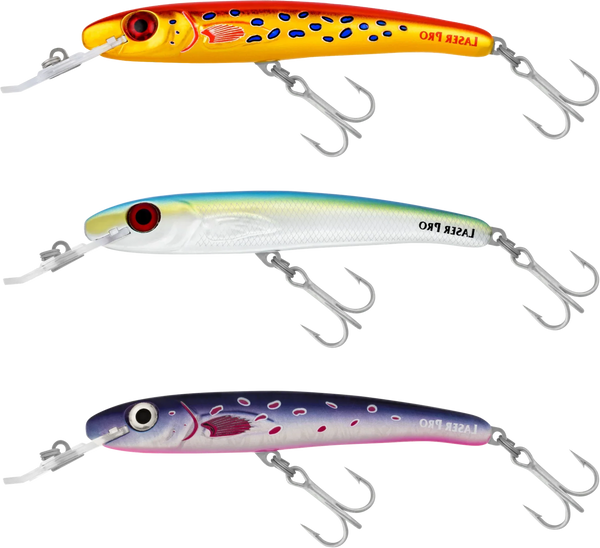
Laser Pro 120 DD
118 mm · 20 g · 1 to 7 kn
NZ Fishing News puts kahawai lures at 6 to 8 cm and 3 to 5 knots; the 120 is the smallest trolling Laser Pro and the one Halco calls its light-tackle trolling lure. Swap the trebles for singles if you release most of them.
Trevally and small pelagics
Laser Pro 140 DD
140 mm · 24 g · 2.5 m
Halco's medium profile for when fish are feeding on smaller baitfish. Runs 2.5 m on its DD bib at 1 to 7 knots, so it suits a slow troll along the weed edge.

Albacore and skipjack
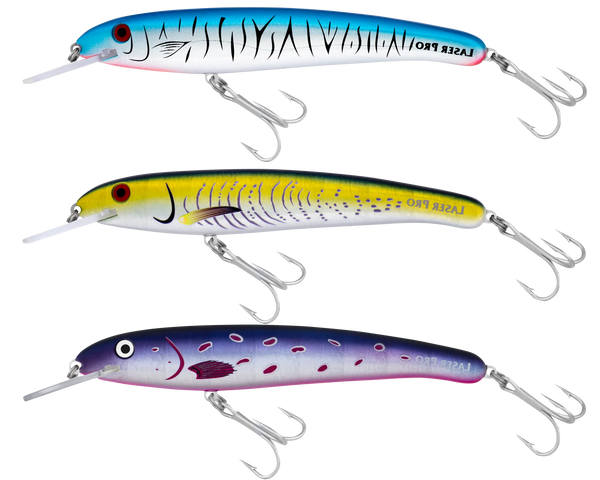
Laser Pro 160 DD
160 mm · 30 g · 2 m DD
Halco built the 160 for mackerel and tuna and says the 140 and 160 match the hatch on small bait. NZ Fishing News kayak anglers take most albacore on 120 to 150 mm minnows.
Kingfish
Laser Pro 190 DD
185 mm · 47 g · 2 m DD
Boating NZ says at least 180 mm to keep undersized kings off, 200 to 240 mm typical. The 190 is Halco's fast-pelagic size: 3 to 11 knots, optimum about 6.5, 4/0 trebles.

Mahimahi and big tuna
Laser Pro 210 XDD
210 mm · 80 g · 9.1 m
Halco's oversized minnow for big pelagics, rated to 12 knots and fitted with two 9/0 BKK inline singles. Mahimahi take trolled bibbed minnows; the 190 covers them too.

Tuna and mahimahi at speed
Halco Max 190 and 220
Bibless, sinking · 12 to 14 knots
The high-speed option: a bibless sinking minnow that tracks straight in a game spread, rated to 12 knots (190) and 14 knots (220), with inline singles. The Max 130 is the small one.
Rated speeds
Laser Pro and Max rated speeds
Halco's rated speed range for each size we stock.
| Lure | Rated speed |
|---|---|
| Laser Pro 120 DD | 1 to 7 knots |
| Laser Pro 140 DD | 1 to 7 knots |
| Laser Pro 160 DD | 3 to 11 knots |
| Laser Pro 190 DD | 3 to 11 knots, best about 6.5 |
| Laser Pro 210 XDD | Up to 12 knots |
| Max 130 | 2 to 12 knots |
| Max 190 | Up to 12 knots |
| Max 220 | Up to 14 knots |
On the troll
Setback and how many lines
Watch the rod tip: a steady pulse means the lure is swimming.
| Question | Answer |
|---|---|
| Speed for kahawai | 3 to 5 knots. Bibbed minnows 4 to 5, a little less for the smallest. |
| Speed for kingfish | 4 to 7 knots, faster at times. Small lures are hard to keep swimming at the top end. |
| Speed for a mixed spread | Set the boat for the smallest lure: with a 120 or 140 out, stay under 7 knots. |
| Setback | 10 to 50 m. With two lures, run one at 20 to 30 m and one at 40 to 50 m, and never less than 10 m for kingfish. |
| How many lines | Two or three lures to start, three or four rods at most on a smaller boat. |
| Where to run them | Longest line out first, then each one shorter. On a boat under 8 m, one lure per wave, and the close lure to one side of the prop wash. |
| Mix the spread | Different depths, sizes and colours, so the lures cover more water and don't tangle on turns. |
| Drag | No more than 8 to 12 kg. |
| Checking the lure | Let it back at least 10 m before judging the action; the bubbling wake lies. |
Depth ratings
Reading Halco's depth ratings
Halco publishes a running depth for each bib, not a dive chart. Four things move the lure off that figure.
The rating is the bib
STD 1 m, DD 2 m, XDD 6 m on the 160 and 190; DD 4.5 m and XDD 9.1 m on the 210; 2.5 m on the 140 DD. Bibs swap between the same model, and Halco supplies DD bibs as the replacement for an XDD.
Braid runs deeper
Boating NZ: braid cuts through the water and lets a trolled lure get deeper; a thick trace is pushed up by water pressure and runs shallower. 27 kg trace for small and medium minnows, 37 to 45 kg for the big ones.
Faster is not deeper
Past the speed band the lure breaks out and loses depth. Halco's optimum for the 190 is about 6.5 knots; slow down to hold depth with a deep bib.
A bent tow point changes everything
Check the tow point and hook hangers are straight. A lure that pulls to one side runs shallower and tangles the spread; bend the tow point a fraction toward the way you want it to swim.
Colours
Colours by water and light
Natural colours for clear water and sun, bright or dark for murky water and low light. Every colour we stock is below.
Clear water, bright sun
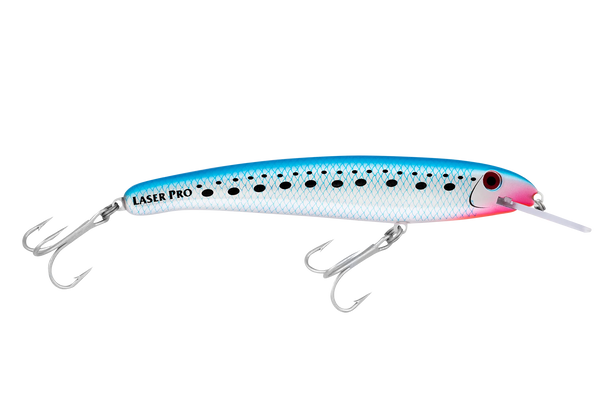
Natural baitfish
Pilchard, Silver Shadow, Baitfish, Chrome Silver Multi
Light, natural colours with silver flash: a pilchard or mackerel in sunlit water.

Overcast or murky
Bright and dark
White Redhead, Fluoro Green, Liquid Lime, Bloodbath
Bright fluoro or dark oranges, reds and browns when the light is low or the water is stirred up.
Kingfish
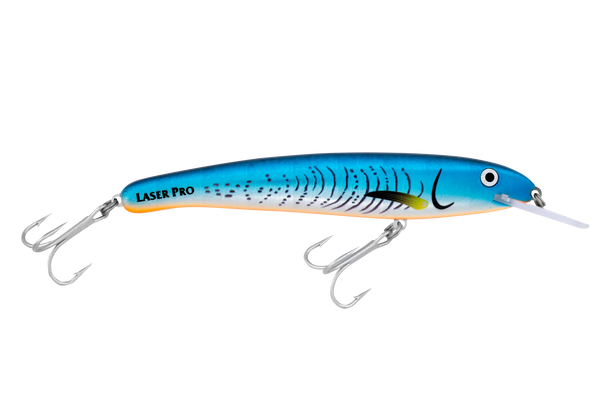
Blue and silver, green and yellow
Blue Fluoro, Liquid Lime, King Brown, White Redhead
Blue and silver, green and yellow in fluoro tones, and white with a red head. Run two colours and let the fish choose.

Tuna
Match the hatch, or pale and dark
Bonito, Yellowfin, Great White, Hoodlum
Bright and reflective bait patterns, or a pale ghost and a purple-black fade when they go off the flash.
Every colour
Every Laser Pro colour we stock
Live from the shelf: pick a size, then a colour. Sold-out colours sit at the end with a Notify me link.
 Pilchard$29.80Clear water
 Rose Tattoo$29.80
 Stripey$29.80
 Yellowfin$29.80Tuna
 Chrome Gold Black Back$29.80
 Blue Fluoro$29.80Kingfish
 Chrome Silver Multi$29.80Clear water
 Baitfish$29.80Clear water
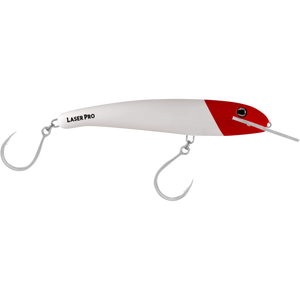
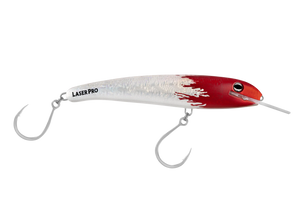
 White Redhead$29.80Murky, low light
 Gravel Rash$27.85
 Fluoro Green$29.80Murky, low light
 Bonito$29.80Tuna
 King Brown$29.80Kingfish
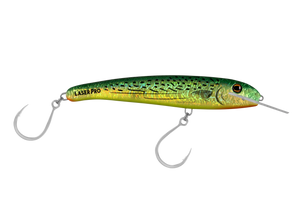
 Liquid Lime$29.80Murky, low light
 Fifo$29.80
 Hoodlum$29.80Tuna
 Great White$29.80Tuna
 Lumo$29.80
 Silver Shadow$29.80Clear water
 Hot Bot$29.80
 Trout Envy$29.80
 Chrome Pink$29.80
 Chrome Tiger$29.80
 Coral Trout$29.80
 Pink Cadillac$29.80
 Bloodbath$27.85Murky, low light
 Golden Green$29.80
 Psychedelic Pink Head$29.80
 Flamin Hot$29.80
 King Brown$26.80Kingfish
 Pilchard$26.80Clear water
 Bonito$26.80Tuna
 Yellowfin$26.80Tuna
 Chrome Gold Black Back$26.80
 White Redhead$26.80Murky, low light
 Baitfish$26.80Clear water
 Stripey$26.80
 Liquid Lime$26.80Murky, low light
 Hoodlum$26.80Tuna
 Great White$26.80Tuna
 Lumo$26.80
 Blue Fluoro$26.80Kingfish
 Silver Shadow$26.80Clear water
 Chrome Pink$26.80
 Chrome Silver Multi$26.80Clear water
 Rose Tattoo$26.80
 Pink Cadillac$26.80
 Bloodbath$26.80Murky, low light



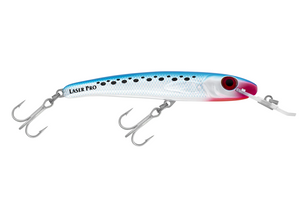

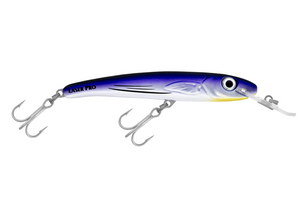

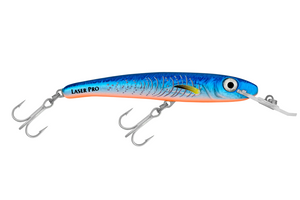


 Pilchard$16.80Clear water
 Chrome Gold Black Back$16.80
 Brown Trout$16.80
 Rainbow Trout$16.80
 Crawfish$16.80
 Pink Fluoro$16.80
 Mullet$16.80
 Golden Green$16.80
 Purple Haze$16.80
 Gravy Train$16.80
 Fire Fin$16.80
 Combat Rock$16.80
 Tickled Pink$16.80
 Jelly PrawnSold out
Notify me
 CaviarSold out
Notify me
 ShadowSold out
Notify me
Rigging and upgrades
Rigging and upgrades
Leader, braid, hooks, rings and the tow point.
Nylon or fluoro, 2 to 3 m
Boating NZ for kingfish: 80 lb sorts most situations, 100 lb for the biggest lures and the gnarliest ground, two to three metres, no wire. Kahawai: two to three metres of 10 to 15 kg fluorocarbon. Tuna: 24 kg clear mono.
Braid main line
Braid runs the lure deeper and tells you more at the rod tip; a nylon leader or a wind-on adds the stretch a trolled strike needs. XBraid Fulldrag X8 and Jigman Ultra are the heavy lines for it.
Trebles or singles
Halco: hook weight changes how a lure swims and floats, and singles may alter the action, so test beside the boat. The 210 ships with 9/0 BKK inline singles; NZ Fishing News swaps kahawai trebles for singles.
Triple Turn rings
Halco's Triple Turn fish rings are rated 70% stronger than a traditional split ring. Tie or crimp to the tow point that carries the ring, and never knot hard up against it.
Loop, not snap
A snap clip interrupts the flow onto the bib and can be levered open; NZ Fishing News uses a loose uni knot or a crimped loop, with a swivel a metre up the trace.
Where and when
Where and when in New Zealand
When and where each fish turns up.
| Fish | When | Where | Notes |
|---|---|---|---|
| Kahawai | All year; workups late winter into summer | All around the coast, harbours and estuaries; white water off islands, headlands and river mouths | Approach a surface school from behind at an angle, never through it. |
| Kingfish | All year at structure; summer inshore | Deep reefs, offshore islands and current-swept headlands; the inner Hauraki Gulf and Waitematā in summer | Push in close to rocks, reefs and bait schools. |
| Albacore and skipjack | December to May | Albacore 13 to 20°C water, Fiordland to the Three Kings, strongest on the west coasts; skipjack 15°C and warmer | Vary colours and set the lures at different lengths. |
| Yellowfin | Late December to April, once offshore water reaches about 19 to 20°C | The north-east coast from East Cape to North Cape when the warm currents push in: Bay of Plenty, East Northland, and north of North Cape in spring | Run the spread faster than for kahawai: the Max 190 and 220 are rated to 12 and 14 knots, the Laser Pro 190 to 11. |
| Mahimahi | A few weeks after the game season opens in mid to late December, until the warm currents retreat in May or June | Cape Egmont around North Cape to Mahia, with the range creeping south | They take trolled bibbed minnows; a first fish of the season often shows mid-November in the Bay of Islands. |
Common mistakes
Common mistakes
Why a lure that caught last time is not catching today.
Judging it in the wake
The lure looks fine in the bubbles and swims badly ten metres back. Set it, then watch the rod tip for a steady pulse.
Too fast for the lure
Small lures skitter and helicopter above 3 to 5 knots; any hardbody breaks out past its band. Match the boat to the smallest lure in the spread.
A bent tow point
It runs to one side, misses its depth and tangles the next line. Straighten the tow point and hook hangers, then tune a fraction at a time.
Trace and clips that kill the action
Thick trace runs the lure shallow; a snap clip spoils the flow over the bib. Loop knot or crimped loop, swivel a metre up.
Too small for kingfish
Under 180 mm hooks rats. Go 190 or 210 when kings are the target.
Weed on the hook
The pulse at the rod tip stops or goes erratic: wind in and clear it. A fouled lure fishes nothing.
Driving through the school
Motoring through feeding fish puts them down. Come from behind at an angle, in the direction they are heading.
Dull hooks
Trebles that have hit rocks miss strikes; check points every trip and replace the hooks, not the lure.
Laser Pro
Halco Laser Pro
Trolling minnows from 47 to 210 mmSix sizes of Halco's floating trolling minnow, from the 6 g Laser Pro 45 to the 80 g 210 XDD, with dual depth bibs on the 160 and 190. Prices and stock are live.
- The mission
- The trolling lure
- Best for
- KahawaiKingfishTunaMahimahi

- best seller

- Staff Pick


Questions
Trolling hardbody questions
Short answers from Halco and the NZ sources on this page.
How far back should the lure run?
Halco says 10 to 50 m. Boating NZ staggers two lures at 20 to 30 m and 40 to 50 m; for kingfish, NZ Fishing News says at least 10 m, and never judge the action in the wake.
Can I troll a Laser Pro on braid?
Yes. Boating NZ says braid gets a trolled lure deeper; put two to three metres of nylon or fluorocarbon leader in front of it for stretch and abrasion. The leader guide covers strengths.
Which bib do I use?
DD is the version we sell on the 120, 140, 160 and 190 and runs about 2 m (2.5 m on the 140). The 210 comes as the 9.1 m XDD with a 4.5 m DD bib. Bibs swap within a model; Halco supplies DD bibs as replacements for an XDD.
Trebles or singles?
Halco warns that changing hook weight or style can change the action, so test it beside the boat. The 210 comes with inline singles from the factory; many NZ anglers fit singles to kahawai lures for an easy release.
Why does my lure run to one side?
A bent tow point or hook hanger. Straighten it, then bend the tow point a fraction of a millimetre toward the direction you want it to swim, as Halco's FAQ describes.
Halco or Rapala?
Both are floating bibbed minnows that troll the same way. The Laser Pro comes in more colours and more sizes than the comparable Rapala models, Halco publishes a rated speed range for every size, and the Laser Pro has a long record on New Zealand kingfish and tuna. It is the one we stock.
What speed for a mixed spread?
Set the boat for the smallest lure. Halco rates the 120 and 140 to 7 knots and the 190 to 11, so a spread with a 120 in it stays under 7. For a fast game spread, the bibless Max 190 and 220 are rated to 12 and 14 knots.
Where the figures come from
Sources
Product pages, FAQ, gear guide
Depths, speeds, hooks and colour counts from each Laser Pro page; patterns, bibs, tow points and tuning from the Halco FAQ; size guidance from the offshore angler's gear guide; rings and bibs from the technology page.
Better put a bib on; leaders for kingfish
How bibs work, setback, drag, braid and trace effects on depth, and the 180 mm kingfish rule.
Trolling for kingfish; kahawai on lures; lure patterns; lure colour; tuna
Speeds, lure sizes, colours, spreads and seasons from fishing.net.nz articles by Mark Kitteridge, John Eichelsheim, Sam Mossman, Steve Tapp, Hayden Speed and Ethan Neville.
Seafood NZ, Black Magic species guide
Yellowfin season and water from Seafood New Zealand (December to March east of NZ between East Cape and North Cape, north of North Cape in September and October) and Black Magic's yellowfin guide (late December at 19 to 20°C until about April, Bay of Plenty).
Related guides
Keep reading

Game fishing
Yellowfin lure guide
The ultimate NZ yellowfin spread position by position: Fatboy anchors, Bonze attractors and Halco enforcers, with the rigging and the captain's tactics.

Game fishing
Fatboy spread guide
Pattern geometry for a strike-ready trolling spread: which Fatboy head goes on which wave, and the mistakes that kill your hook-up rate.
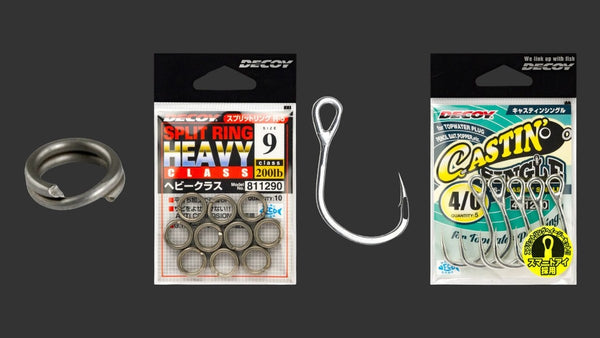
Terminal tackle
Topwater terminal guide
Rings, hooks, swivels and leaders for topwater kingfish and tuna: how each link fails, what to run for each fish, and how to rig and check it.

Lines
Leader guide
XBraid vs Black Magic leaders strength for strength, fluoro vs nylon, which leader and length for each fishing, and the braid-to-leader knots.